actualites
Flowcus: When Two Students Turn Their Summer into an Entrepreneurial Project
Flowcus: When Two Students Turn Their Summer into an Entrepreneurial Project

While most students choose to spend their summer working in a company to validate their internship, we, Alexandre Lagarde and Nathanaël Guilbault, made a different bet.
During our first year of the Bachelor in Business & Data at Albert School, we decided to create our own project instead of joining a company for an internship.
Our goal: to design a useful, modern, and intelligent product that meets a real, everyday need.
From this initiative, Flowcus was born—an AI-powered productivity and time management app. It’s a project at the crossroads of technology, personal organization, and entrepreneurship, perfectly reflecting the spirit of innovation encouraged at Albert School.
From Idea to Conception: The Birth of Flowcus
The story of Flowcus began in class, at a seemingly ordinary moment.
We discovered Lovable, a new no-code/low-code development platform released only a few weeks before. We immediately saw a rare opportunity: a fresh tool, barely explored, allowing us to quickly design web applications without having to code and structure everything manually from scratch.
Our first idea was ambitious: offer professional website creation services for businesses and individuals, using Lovable to guarantee high-quality, effective, and accessible sites without the need for a web designer.
However, we quickly realized that this market was already saturated and that attracting clients proved difficult, despite our efforts to approach businesses around the school—mainly restaurants—to offer our services.
We then considered an integrated school platform, gathering essential tools for students: timetables, grades, calendar, messaging, assignment submissions. At the same time, Albert School's intranet was being developed.
So, we decided to return to our real needs and those of our peers. By talking with other students in our class, a clear problem emerged: lack of organization. Between classes, projects, sports, studying, and personal life, many students struggled to balance their time and stay focused on their priorities.
From this discussion, the idea of Flowcus was born—a name formed from Flow (the state of optimal concentration) and Focus (directed attention).
Before moving forward, Alexandre created a complete brain map of the project: features, needs, user journey, architecture, and feasibility. This structure allowed us to lay the foundations for a concrete project, ambitious enough to replace our internship.
150 Hours of Work to Build a Functional Prototype
The Flowcus adventure stretched over the entire summer—about 150 hours of combined thinking, development, testing, and iterations.
The roles naturally split:
- Nathanaël handled all technical development: API integration, database management, calendar synchronization, and optimization logic.
- Alexandre—who was also doing an internship at the time—focused on testing, troubleshooting, and suggesting improvements, while ensuring a consistent user experience and design (UX & UI).
This complementarity made our collaboration smooth and efficient, much like the product we were building.
A Complete and Ambitious Architecture
For a student project, Flowcus rests on a surprisingly robust technical foundation:
- Lovable for rapid front-end design
- Supabase for backend, data management, and authentication
- Google Calendar API for automatic schedule synchronization
- OpenAI API for analyzing goals and providing smart organization suggestions
- Resend for automated email sending
- Stripe for premium subscription management
-
Technical Challenges
One of our biggest challenges was the optimization algorithm. It needed to analyze a schedule, understand the user’s personal goals, and then generate a new, intelligent, and realistic organization through ChatGPT.
Our greatest technical achievement was connecting with the Google Calendar API, known for its complexity. After many tests and adjustments, we managed to set up a smooth and secure synchronization. At that moment, Flowcus moved from concept to reality: a functional app capable of interacting with everyday tools.
A Tool Designed to Meet a Universal Need
Flowcus addresses an issue we share with many students and young professionals: lack of organization in an ever-accelerating world.
Between academic pressure, personal projects, and social life, it becomes difficult to plan days effectively without compromising balance and well-being.
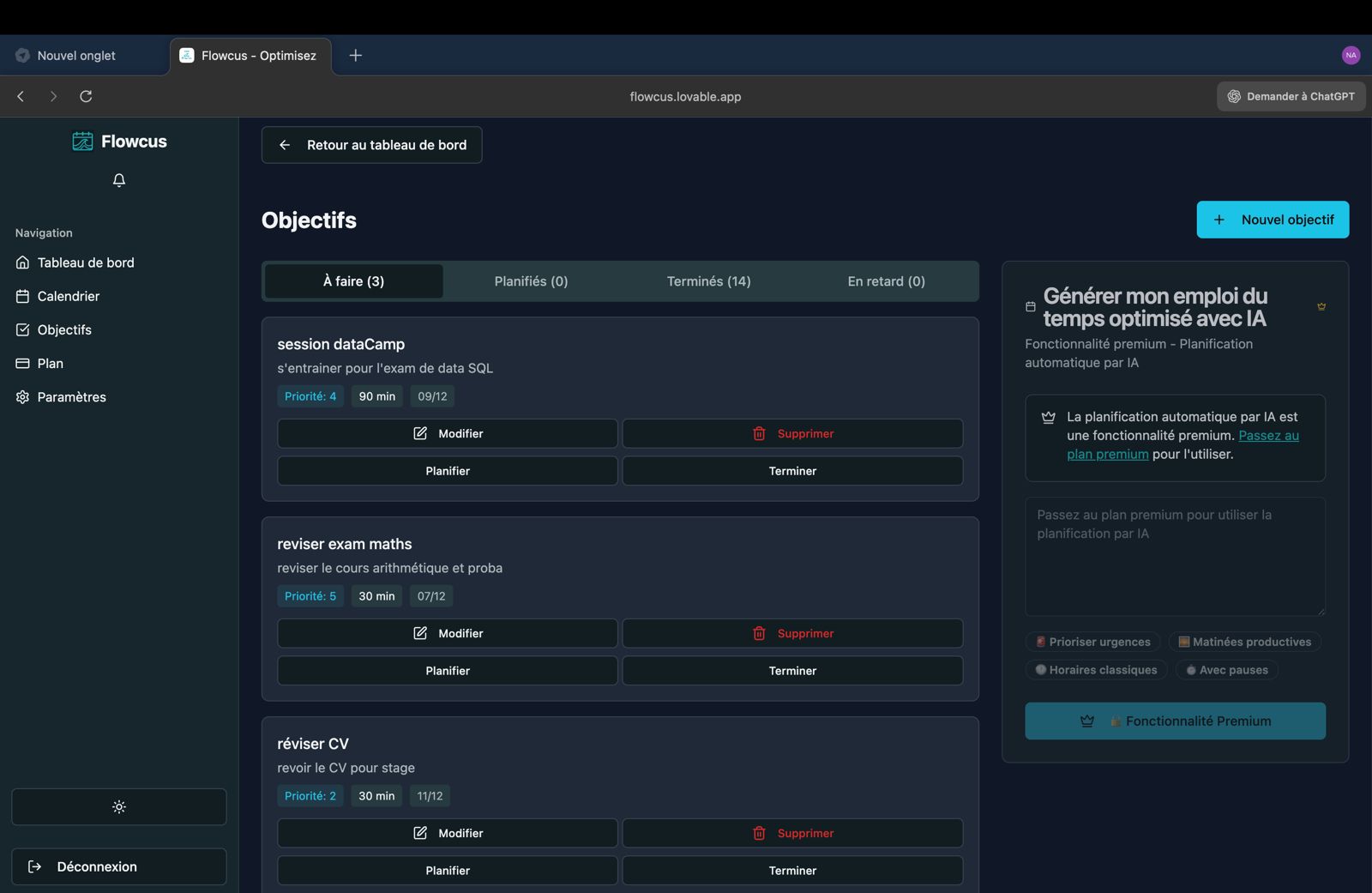
The app acts as an intelligent organization coach: it analyzes the existing calendar, understands priorities, and suggests relevant adjustments.
Its key features include:
- automatic reorganization of work slots,
- personalized advice based on goals,
- an analytics dashboard to track productivity.
The goal of Flowcus isn’t to turn the user into a machine, but to help them find a balance between efficiency and well-being.
A Long-Term Vision
With six more months and a dedicated budget, we would have liked to:
- launch a native mobile app (already accessible via web),
- purchase a domain to host Flowcus and certify Google integration,
- upgrade our OpenAI and Supabase plans for more power,
- start a real marketing campaign to promote the product.
Our vision is clear: to make Flowcus a reference for student and personal organization, a digital assistant that adapts to everyone’s needs.
A Structured Business Model
Flowcus already includes a premium subscription system in its prototype. The free version allows manual schedule management, while the paid version unlocks:
- AI optimization,
- personalized advice,
- advanced dashboards.
We plan to present the project to Albert School’s administration to consider real use by students. It would be a strong symbol: a tool designed by students, for students.
A 360° Learning Experience
Beyond technical achievement, Flowcus has been an incredible lesson in collaboration and autonomy for us.
- Alexandre focused on strategy, design, and overall user experience consistency.
- Nathanaël invested in development, API integration, and product logic.
Our complementarity led to a coherent, ergonomic, and efficient result.
This project also strengthened Nathanaël’s confidence in his skills as a developer and project manager. He learned to overcome technical obstacles and to be creative with limited resources.
As for Alexandre, he honed his ability to drive product vision and user experience: by continuously testing and improving the app, he learned to turn each adjustment into a tangible improvement, and to explore the potential of no-code and low-code tools.
Flowcus perfectly illustrates Albert School’s philosophy: learning by building, entrepreneurship through experimentation.
We put into practice what the school teaches daily: rigor, initiative, and technological curiosity.
Conclusion
“Flowcus is the tool that analyzes your schedule, understands your goals, and helps you organize everything better.”
In just a few weeks, we managed to turn an idea born in class into a complete, functional, and promising prototype. Our journey is a testament to a desire to learn differently, to push boundaries, and to make our ambitions real.
Flowcus is not just an app—it’s the symbol of a mindset: that of two young creators who chose to build rather than watch, invent rather than wait, and turn a summer internship into a unique entrepreneurial experience.
With Flowcus, we show that at Albert School, innovation is not just learned in books—it’s lived, coded, and shared.
Nathanaël Guilbault & Alexandre Lagarde
While most students choose to spend their summer working in a company to validate their internship, we, Alexandre Lagarde and Nathanaël Guilbault, made a different bet.
During our first year of the Bachelor in Business & Data at Albert School, we decided to create our own project instead of joining a company for an internship.
Our goal: to design a useful, modern, and intelligent product that meets a real, everyday need.
From this initiative, Flowcus was born—an AI-powered productivity and time management app. It’s a project at the crossroads of technology, personal organization, and entrepreneurship, perfectly reflecting the spirit of innovation encouraged at Albert School.
From Idea to Conception: The Birth of Flowcus
The story of Flowcus began in class, at a seemingly ordinary moment.
We discovered Lovable, a new no-code/low-code development platform released only a few weeks before. We immediately saw a rare opportunity: a fresh tool, barely explored, allowing us to quickly design web applications without having to code and structure everything manually from scratch.
Our first idea was ambitious: offer professional website creation services for businesses and individuals, using Lovable to guarantee high-quality, effective, and accessible sites without the need for a web designer.
However, we quickly realized that this market was already saturated and that attracting clients proved difficult, despite our efforts to approach businesses around the school—mainly restaurants—to offer our services.
We then considered an integrated school platform, gathering essential tools for students: timetables, grades, calendar, messaging, assignment submissions. At the same time, Albert School's intranet was being developed.
So, we decided to return to our real needs and those of our peers. By talking with other students in our class, a clear problem emerged: lack of organization. Between classes, projects, sports, studying, and personal life, many students struggled to balance their time and stay focused on their priorities.
From this discussion, the idea of Flowcus was born—a name formed from Flow (the state of optimal concentration) and Focus (directed attention).
Before moving forward, Alexandre created a complete brain map of the project: features, needs, user journey, architecture, and feasibility. This structure allowed us to lay the foundations for a concrete project, ambitious enough to replace our internship.
150 Hours of Work to Build a Functional Prototype
The Flowcus adventure stretched over the entire summer—about 150 hours of combined thinking, development, testing, and iterations.
The roles naturally split:
- Nathanaël handled all technical development: API integration, database management, calendar synchronization, and optimization logic.
- Alexandre—who was also doing an internship at the time—focused on testing, troubleshooting, and suggesting improvements, while ensuring a consistent user experience and design (UX & UI).
This complementarity made our collaboration smooth and efficient, much like the product we were building.
A Complete and Ambitious Architecture
For a student project, Flowcus rests on a surprisingly robust technical foundation:
- Lovable for rapid front-end design
- Supabase for backend, data management, and authentication
- Google Calendar API for automatic schedule synchronization
- OpenAI API for analyzing goals and providing smart organization suggestions
- Resend for automated email sending
- Stripe for premium subscription management
-
Technical Challenges
One of our biggest challenges was the optimization algorithm. It needed to analyze a schedule, understand the user’s personal goals, and then generate a new, intelligent, and realistic organization through ChatGPT.
Our greatest technical achievement was connecting with the Google Calendar API, known for its complexity. After many tests and adjustments, we managed to set up a smooth and secure synchronization. At that moment, Flowcus moved from concept to reality: a functional app capable of interacting with everyday tools.
A Tool Designed to Meet a Universal Need
Flowcus addresses an issue we share with many students and young professionals: lack of organization in an ever-accelerating world.
Between academic pressure, personal projects, and social life, it becomes difficult to plan days effectively without compromising balance and well-being.
The app acts as an intelligent organization coach: it analyzes the existing calendar, understands priorities, and suggests relevant adjustments.
Its key features include:
- automatic reorganization of work slots,
- personalized advice based on goals,
- an analytics dashboard to track productivity.
The goal of Flowcus isn’t to turn the user into a machine, but to help them find a balance between efficiency and well-being.
A Long-Term Vision
With six more months and a dedicated budget, we would have liked to:
- launch a native mobile app (already accessible via web),
- purchase a domain to host Flowcus and certify Google integration,
- upgrade our OpenAI and Supabase plans for more power,
- start a real marketing campaign to promote the product.
Our vision is clear: to make Flowcus a reference for student and personal organization, a digital assistant that adapts to everyone’s needs.
A Structured Business Model
Flowcus already includes a premium subscription system in its prototype. The free version allows manual schedule management, while the paid version unlocks:
- AI optimization,
- personalized advice,
- advanced dashboards.
We plan to present the project to Albert School’s administration to consider real use by students. It would be a strong symbol: a tool designed by students, for students.
A 360° Learning Experience
Beyond technical achievement, Flowcus has been an incredible lesson in collaboration and autonomy for us.
- Alexandre focused on strategy, design, and overall user experience consistency.
- Nathanaël invested in development, API integration, and product logic.
Our complementarity led to a coherent, ergonomic, and efficient result.
This project also strengthened Nathanaël’s confidence in his skills as a developer and project manager. He learned to overcome technical obstacles and to be creative with limited resources.
As for Alexandre, he honed his ability to drive product vision and user experience: by continuously testing and improving the app, he learned to turn each adjustment into a tangible improvement, and to explore the potential of no-code and low-code tools.
Flowcus perfectly illustrates Albert School’s philosophy: learning by building, entrepreneurship through experimentation.
We put into practice what the school teaches daily: rigor, initiative, and technological curiosity.
Conclusion
“Flowcus is the tool that analyzes your schedule, understands your goals, and helps you organize everything better.”
In just a few weeks, we managed to turn an idea born in class into a complete, functional, and promising prototype. Our journey is a testament to a desire to learn differently, to push boundaries, and to make our ambitions real.
Flowcus is not just an app—it’s the symbol of a mindset: that of two young creators who chose to build rather than watch, invent rather than wait, and turn a summer internship into a unique entrepreneurial experience.
With Flowcus, we show that at Albert School, innovation is not just learned in books—it’s lived, coded, and shared.
Nathanaël Guilbault & Alexandre Lagarde
Hear from our students about their amazing journeys and achievements

At Albert School, the student council fosters community and learning through events. By bringing students together, we enhance campus life and create connections, contributing to develop new soft skills.
Sulian
Bachelor in Business, Data, & AI
Bachelor Business, Data, & AI
Paris

What I like best about Albert School is how the professors foster our ambition and encourage us to have an entrepreneurial mindset!
Prisca
International BBA Business, Data, & AI - General Secretary of the Student Council
International BBA Business, Data, & AI
.png)
“The Business Deep Dives pushed me to grow beyond what I thought possible—turning lessons into real-world experience alongside inspiring companies.”
Samuel
International BBA Business, Data, & AI - Samuel, Student from Rwanda
International BBA Business, Data, & AI
